26.1. Introduction
Released as hex-lll, with the Mathlib correspondence in hex-lll-mathlib.
HexLLL reduces an integer lattice basis. Given the rows of a
Hex.Matrix over Int, it produces a new basis for the same
lattice made of short, nearly orthogonal vectors (the LLL guarantee).
Its first row is a provably short lattice vector, which is what the
downstream factorization path consumes:
the BHKS van Hoeij recombination step in hex-berlekamp-zassenhaus
reconstructs true factors from short vectors of a knapsack lattice.
On adversarial worst-case input the reducers diverge sharply in cost. These are the
five benchmarked reducers on fplll's Ajtai-style gen_trg bases, whose steeply
decreasing profile forces a Θ(d² log B) swap count:
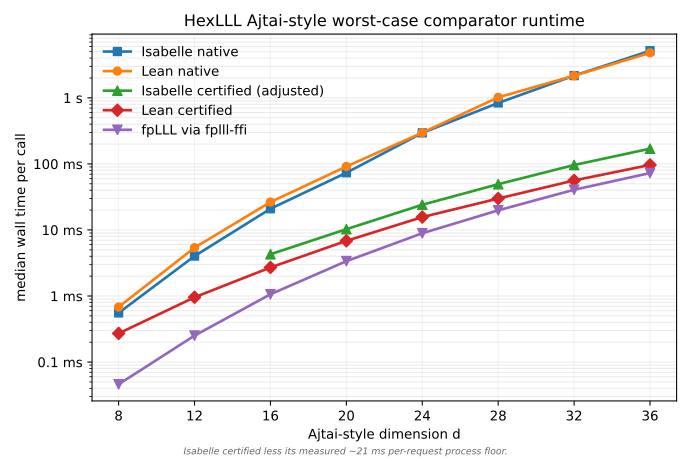
The exact integer reducers (Lean's Hex.lllNative and the verified Isabelle
extraction) blow up ~d⁷. The certified path (an fpLLL candidate
checked by a verified Lean checker) stays cheap, near raw floating-point speed.
The performance comparison below describes every
curve and all six input families.
The library splits computation from proof. The public reducer can
accelerate through an optional external fpLLL reducer (fast, untrusted
numerics), but no proof depends on those numerics being correct. Every
external candidate is fed through a verified integer checker. Only a basis
the checker accepts is returned, and the checker's soundness theorem
(proved on the Mathlib side) turns that acceptance into the mathematical
guarantee. When no external candidate certifies, the exact all-integer
reducer Hex.lllNative runs directly, and its guarantee is proved outright.
HexLLL is Mathlib-free. It takes the Gram-Schmidt machinery underlying
both the predicates and the checkers from
HexGramSchmidt, which computes the
leading integer Gram determinants by fraction-free (Bareiss) elimination and
so rests in turn on HexBareiss, HexDeterminant, and HexRowReduce.